Disclaimer: This article is in no way intended to encourage drug use. Its purpose is to provide information about certain (unusual) practices and the scientific research surrounding them.
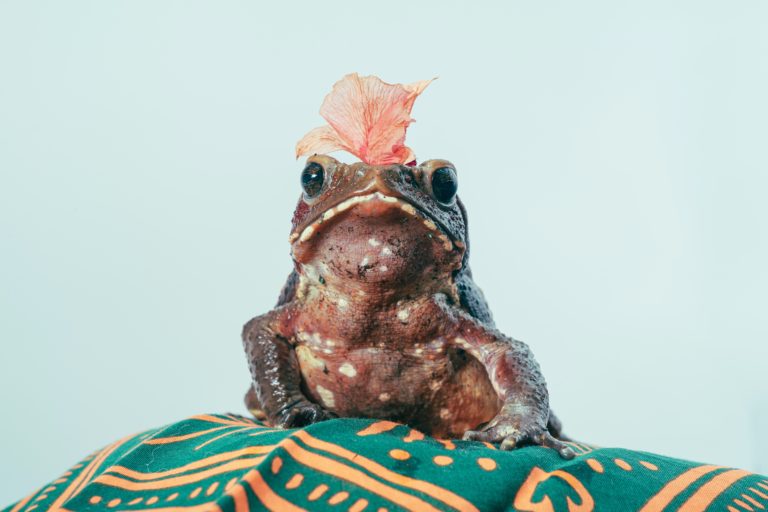
On a hot summer night, suffering from severe insomnia, I stepped out onto the terrace—and who should I see? A common toad (Bufo bufo), perched astride the threshold of the open door. When we saw each other, we froze to get a better look at one another—he, assessing the danger, and I, not wanting to disturb the charming creature.
My imaginative mind wondered, “What if I tried to kiss him? Maybe fairy tales know more than I do?” Just having that thought obviously made him run away as I tried to get closer.
Especially since that wouldn’t be the brightest idea I’ve ever had. Toads’ skin is actually covered with a mucus that’s particularly rich in toxic substances, which helps defend them against predators. Without these toxins, toads would be small, fragile, delicate, and particularly vulnerable animals. That’s why it’s recommended to wash your hands after touching a toad*, to avoid ingesting these toxins.
Prince Charming: Just a Beautiful Hallucination?
I seemed to recall that the toads that turn into Prince Charming in fairy tales were somehow connected to these molecules. So, rather than witnessing a magical transformation, the princess would go on a psychedelic trip caused by the toad’s toxins coming into contact with her mucous membranes. Similarly, it seemed to me that toads were particularly associated with witches because of these same molecules, which are generally classified as toxic poisons but are also psychedelic**.
After doing some research, my illusions about our beloved common toad were replaced by a certain fascination with other toad species, notably Incilius alvarius (formerly Bufo alvarius), whose venom does indeed contain psychoactive substances. The common toad, on the other hand, defends itself with molecules that would cause severe digestive, nervous, and cardiac disorders if ingested—so don’t even think about trying it!
Beef toxins and uses
Bufotoxins are a large family of molecules found in the parotid glands, skin, and venom of certain toads. Depending on the species, different molecules may be predominant. Toads do not have a monopoly on them, however: other amphibians, as well as certain species of plants and fungi, also produce them!
Incilius alvarius is the toad best known for its psychoactive secretions. Some people even go so far as to lick it, which is particularly unadvisable, as you’re ingesting molecules that will at the very least cause serious indigestion, if not cardiac and neurological disorders.
Others “milk” the toad’s parotid glands to secrete venom rich in psychoactive molecules, notably 5-MeO-DMT and 5-HO-DMT. These molecules are analogous to DMT, the psychoactive molecule in ayahuasca and many similar ritual preparations. The venom is then dried and smoked to induce a psychedelic trip similar to ayahuasca, but of shorter duration.
DMT, physiology and the psychedelic experience
DMT is found physiologically in small quantities in the human body, which leads us to assume that it has some function as a neurotransmitter. It has also been hypothesized that this molecule is important in the experience of dreams, and that its secretion is maximal at the moment of death.
Möckel writes about the psychedelic experience with DMT: “Nothing can prepare you for this experience! The ordinary world is instantly replaced by an alien world. The ego dissolves, and one finds oneself in bizarre worlds, ranging up to out-of-body experiences or loss of consciousness. This leads to intense visual hallucinations, kaleidoscopic patterns—‘everything moves at the speed of light’—with a distorted perception of time. The experience can range from heaven to hell.”
Notes
* It’s also important to note that, like all amphibians, toads need to keep their skin moist at all times in order to breathe. In fact, they absorb most of their oxygen through their skin! So don’t touch them unless your hands are thoroughly wet and clean! Furthermore, all amphibians are protected in Switzerland. So don’t handle them unless you’re saving them from immediate danger, and don’t take them out of their natural habitat to bring them home (this also applies to children and tadpole breeding projects). [Back to the text]
** Don’t forget Paracelsus’ famous saying, “The dose makes the poison!” Everything can be useful; everything can be poisonous—it’s just a matter of dosage. [Back to text]
Hostettmann, K. Drugs of natural origin. Editions Favre, 2018.
Hostettmann, K. All about natural poisons. Editions Favre, 2006.
Möckel, C. Journey of consciousness towards healing. Edition Solanacée, 2022.
Further information
The Swiss foundation ALPS (Awareness Lectures on Psychedelic Science) organizes conferences on research into psychedelic-assisted therapies. I was lucky enough to attend their convention in 2022 and found every lecture fascinating. You can follow them on their YouTube channel, where they rebroadcast their conferences in their entirety.