In autumn 2021, I took a course in non-violent communication (NVC) with Pascal Gremaud as part of anEPSN training program.
I already had a few basics, I knew how to listen to others, how to formulate “I” impressions and those little tools you hear 50,000 times when you train in complementary therapies and have a minimum interest in the psychology of human communication. However, I hadn’t got to the bottom of the principle and since I’ve understood the feelings and needs behind any conflict, I communicate better, express myself more accurately and hear better what the other person is feeling.
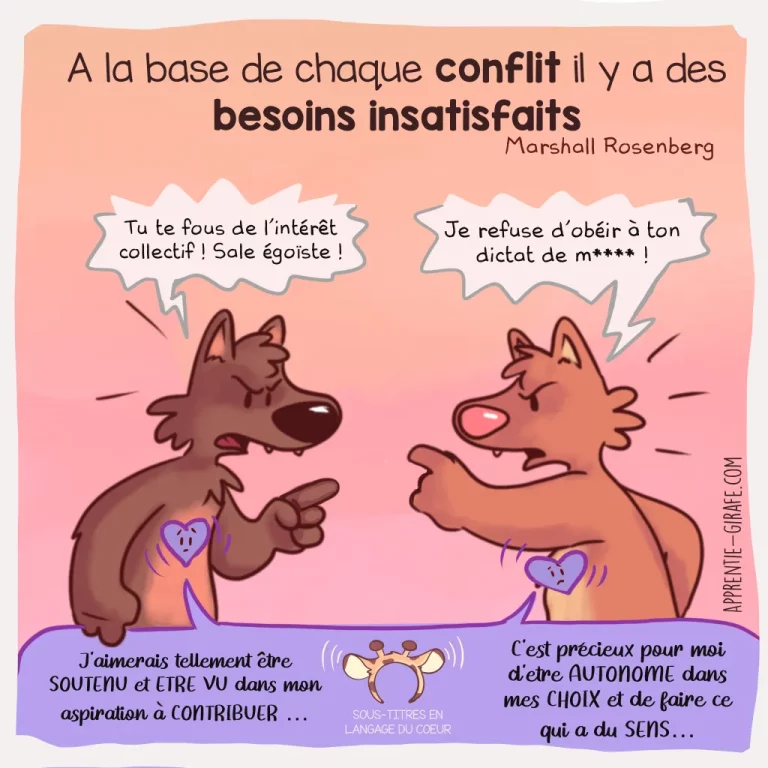
Yes, expressing your feelings in the first person is a good starting point, as this formulation allows you to identify yourself as the subject of the feeling rather than expressing your feelings as a supposedly objective fact. But saying “I feel you’re very aggressive” isn’t much of an improvement over “dude, you’re super aggressive right now”! It will be all the more relevant to ask ourselves why we perceive aggression coming from the other, what sensations and emotions we feel at that moment, and what of our fundamental needs, inherent to every human being, are not being met. Aggression in itself is often no more than a defense mechanism, tending to indicate an internal effervescence in the other person that he/she is unable to express in any other way. Thus, it’s more than likely that both parties are feeling unpleasant emotions at this moment, and would benefit from being able to observe and accurately express what’s going on inside them.
I’ve chosen to useApprentie Girafe ‘s wonderful illustrations for this article, feel free to have a look at their blog, I find it magical! Every time I visit, he warms my heart and I learn something new ❤️
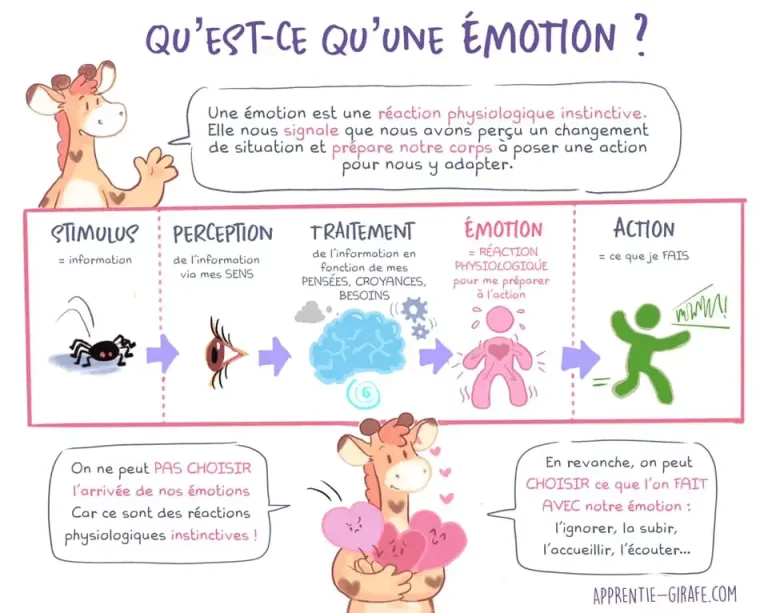
Contrary to what we have all too often been taught, our emotions are not trivial or useless things that prevent us from functioning properly and that should therefore be controlled. Rather, they are physiological reactions to our perception of a stimulus, processed through the filters of our life experiences, the beliefs we have formed as a result of those experiences, and the mechanisms our brain has put in place to protect and defend us against life-threatening dangers and unpleasant emotions.
So what we feel is particularly useful, even vital! Do you really think our evolution would have created such complex, energy-consuming mechanisms if they served no purpose? In fact, neuroscience is helping to elucidate how they are set up at the level of brain development – it’s an absolutely fascinating subject!
In conclusion, it’s best to welcome and listen to our emotions. Sometimes this simple conscious action is enough. In other cases, it will help identify the cause so that it can be addressed and treated.
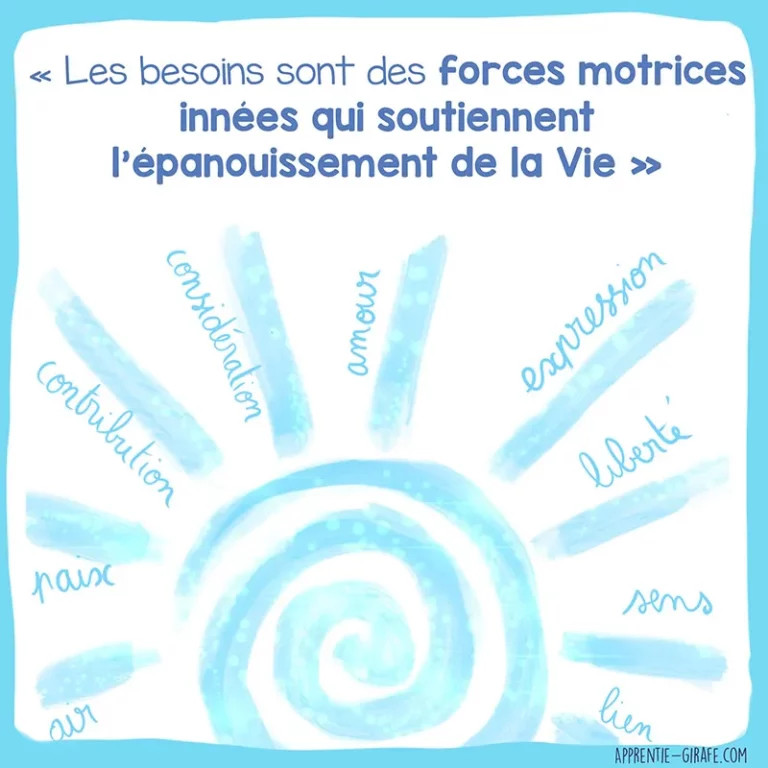
Behind every conflict and every emotion are needs. I’m talking about the basic needs common to all human beings, such as security, love, sharing, tenderness, spirituality, rest, movement, understanding, cooperation, etc.
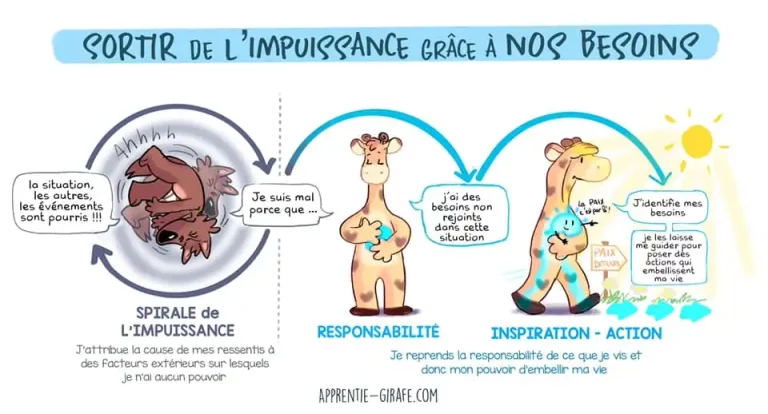
In reality, conflicts, like unpleasant emotions (often called negative emotions), indicate needs that are not being met in the current situation. These are opportunities to listen to ourselves, to identify the needs we have, and to put in place strategies that suit us fully in order to fulfill them.
Conversely, pleasant emotions (often referred to as positive) indicate needs that are being met in the current situation. For example, I feel joy writing this post because it helps fulfill my need to share 🥰 (…and a little fatigue given the hour, which indicates a need for rest that I’ll soon go and fulfill!).
The notion of needing someone to do something is generally wrong. Basic needs never imply a specific person or a specific action. When this is the case, we’re no longer dealing with needs, but with strategies for meeting those needs.
For example, I once thought I needed my flatmate to clean and tidy his dishes after his meal. In reality, I needed order and cleanliness, and when he left his dishes lying around, it went against those needs. Similarly, I “needed” his help with the garden. In reality, I did need help, but any of my other friends, or even a landscaper, could help me fulfill my need for help at that moment.
Similarly, I’m a very tactile person. I love hugs; I often hold the hands of the people I love to show them my support and affection; and I easily make affectionate gestures, like giving a friend a little scratch on the back when I walk up behind them in the kitchen. All these gestures are strategies that help fulfill my needs for love, tenderness, sharing, self-expression, and simply human connection. One or another of these needs may be predominant depending on the moment, and these are the strategies that primarily help me fulfill them. They’re also the strategies that come to me spontaneously when I sense these needs in the person in front of me. But they aren’t the only ones that exist. The strategies I’ve just listed represent only one of the five love languages (physical touch, words of affirmation, gifts, spending quality time together, acts of service), and I’m still only talking about the need for love (it’s one of my favorites).
For each of these needs, we therefore have an infinite number of possible strategies, which we can use on our own or with others. For example, we can give ourselves an inner hug and say positive affirmations to ourselves while treating ourselves to a meal at our favorite restaurant (I love this strategy): in doing so, you’ll have used several of the languages of self-love to fulfill that need. And if you’re thinking, “But that’s no fun on my own,” it’s likely because your need for connection or human contact is more pressing right now